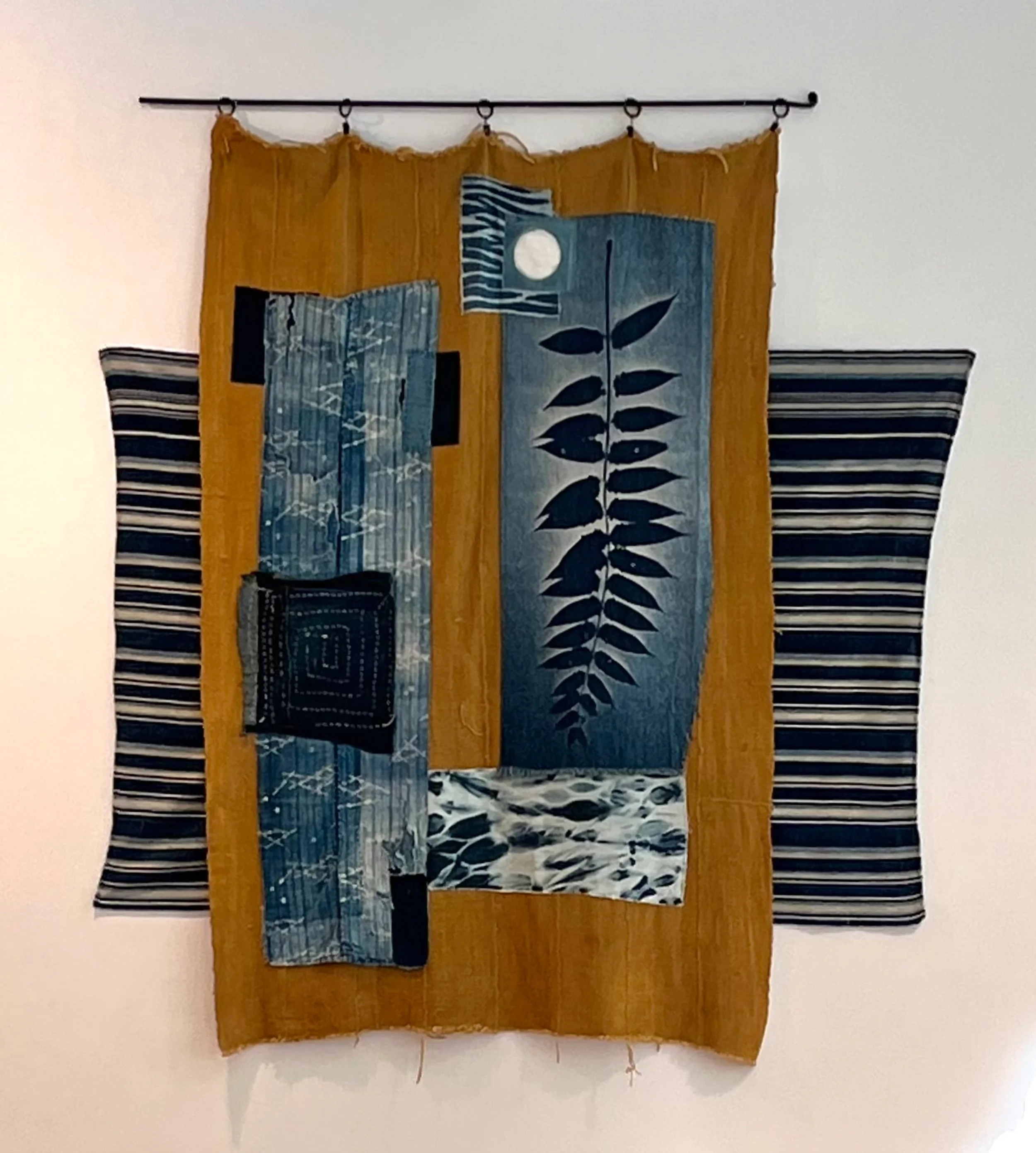
BLUE GOLD
2022-2024
Clockwise from top: Round shibori and striped shibori, Rachel Switzer @capecodshibori;
bleach discharge, David Klein, Ailanthus, 1977;
shibori, Rachel Switzer @capecodshibori;
vintage Japanese Katazome, plum blossom branch, late 19th c. Japanese Zokin 20th c.;
Japanese ochre mud cloth, West Africa;
striped indigo blanket, West Africa.
65 x 58”
Exhibited Southern Vermont Arts Center 2024, Exhibited AVA Gallery 2024
I began this piece two years ago and finished it in early spring this year, one week before the total solar eclipse, in Burlington, Vermont.
Only after a friend asked me if there was a reference to the eclipse in this piece, did I see it throughout: tonal shifts in faded cloth, the dark leaves and bright coronas in the Ailanthus branch, overall dark and light contrasts, and a color palette of bright yellow sun and dark blue night.
It also unintentionally references early spring. Thanks to @srithreads for identify blossoming Plum branches in the Japanese Katazome on the left, and @Lydeia for identifying the Ailanthus branch on the right; they both are among the very first trees to bud in the spring.
The title of the piece, Blue Gold, refers to the name given to Indigo when it played a central role in the transatlantic slave economy. The value of Indigo as a luxury trade good throughout the world resulted in brutal practices around its farming, from India to Haiti to South Carolina. The title frames the beauty of Indigo with the historical cruelty of its production, giving a fuller background to the ongoing appreciation of the dye and the cloth.
My works often ruminate for several years. Frequently, it is after I lay out, or even complete the work, that all of its connections, meanings, and resonances become clear to me.
$3,200
